
.png)
[Dutch noun] The einder; noun (m.); Pronounciation: [’ɛindər] Declension: einder|s (plur.) Meaning: the imaginary border between the sky and the surface of the earth where the two seem to meet.
EINDER is presented by Studio Boris Acket, Making Waves, and Goonie Crew to celebrate the 30th anniversary of ADE.
The exhibition is supported by Anthropic.
Large fields of fabric are suspended in space and activated by carefully constructed systems of air, tension, gravity and light. These systems create the conditions for movement without determining its outcome. Wind travels through and across the material, forming waves, folds and temporary landscapes that continuously appear and disappear. The work exists in the tension between control and surrender: an extensive technological apparatus is built to create a situation that can ultimately never be fully controlled.
The title Einder, the Dutch word for horizon, refers to something that is visible but impossible to reach. Within the work, the horizon becomes less a fixed line than a continuously shifting condition. The fabric can appear as water, cloud, skin or landscape, while remaining nothing more than fabric moved by air. Repetition gradually makes small differences increasingly perceptible. A movement may return, but never in exactly the same form. In this sense, EINDER is as much concerned with duration as with movement: perception develops through what has just happened and what we anticipate might happen next.
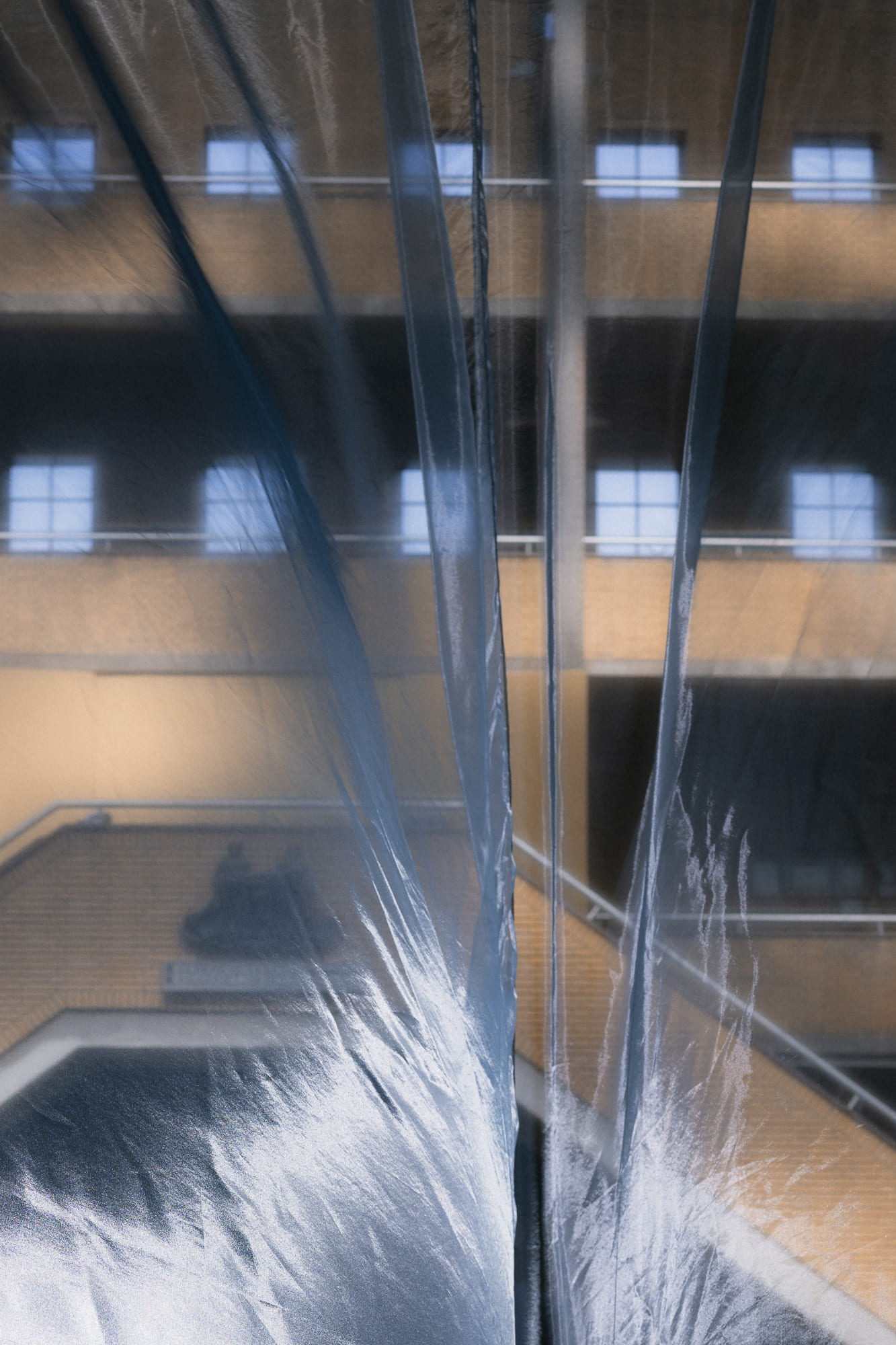
Each has its own system of ventilators and control, allowing two independent fields of wind to exist alongside one another. Air moves across, underneath and between the surfaces, creating moments in which their behaviour converges and others in which they seem to resist each other entirely. At times they can be perceived as a single landscape; at others, as two separate bodies responding to invisible forces. Their proximity introduces another layer of instability, as the conditions created by one surface inevitably become part of the environment of the other.
Behind this seemingly elemental encounter sits an intricate technological system: hundreds of ventilators, light and control protocols working continuously to produce and manipulate something as simple and ancient as moving air. This contradiction is central to EINDER. Technology does not replace the natural phenomenon but becomes a way of making it perceptible again. The more precisely the system attempts to shape the wind, the more clearly its autonomy becomes visible. What remains is a continuously changing field in which machine, material and atmosphere negotiate with one another, without ever arriving at a final form.
